Small Size Notes
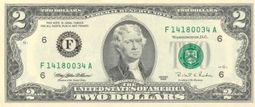
The United States two-dollar bill ($2) is a denomination of U.S. currency. Former U.S. President Thomas Jefferson is featured on the obverse of the note. The painting The Declaration of Independence by John Trumbull is featured on the reverse. more...
The current reverse and obverse (with features of a Federal Reserve Note) have been used since 1976.
In spite of its relatively low value, the two dollar bill is one of the most rarely-seen denominations of U.S. currency. This is partially due to the low production of the note; approximately 1% of all notes produced today are $2 bills. Two dollar bills aren't frequently reissued in a new series like other denominations. This is because bills are printed according to demand. When the Federal Reserve Banking System runs low on its current supply of $2 bills, it will submit an order to the Bureau of Engraving and Printing, which will then print more. Demand for $2 bills is low enough that one printing can last for many years. There is still a large supply of series 1976 bills, that have not been circulated.
When the current note was first issued in 1976, it was met with general curiosity, and was seen as a collectable, not as a piece of regularly circulating currency, which the Treasury intended it to be. The main reason it failed to circulate was that businesses never really requested them as part of their normal operations to give back out in change. This failure is linked to the gradual disappearance of the former $2 note, the $2 United States Note, featuring Monticello on the reverse, printed and issued from 1862 to 1966.
Read more at Wikipedia.org